

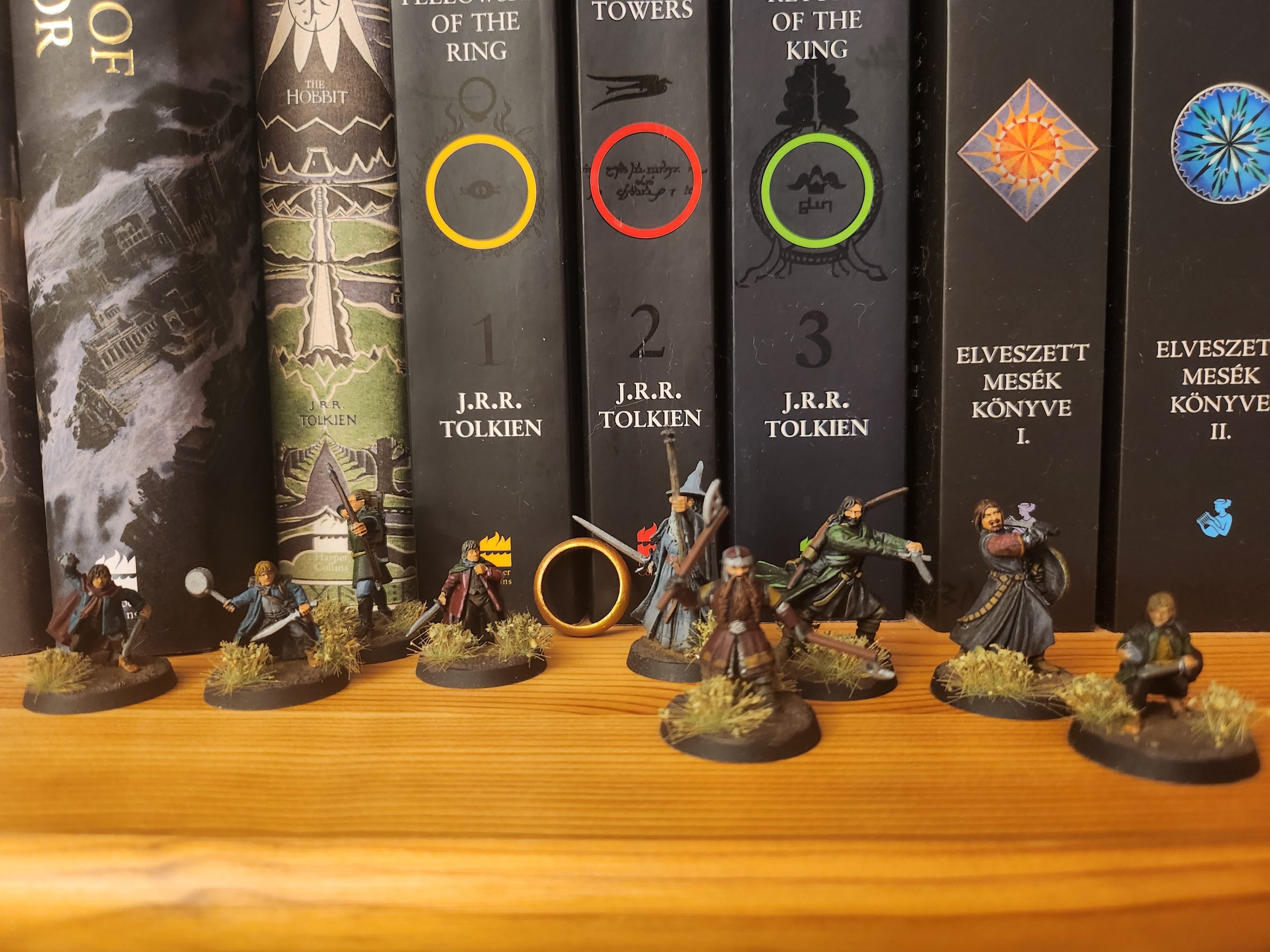
Tolkien’s stories continue to speak to us across generations because his heroes are not distant, flawless figures. They are not great because they never feel fear. They are not worthy of admiration because they are untouched by pain, loss, or doubt. Quite the opposite: in Tolkien’s world, heroism often begins precisely where a person is already tired, wounded, uncertain, and yet still finds the strength to go on.

Aragorn, for example, is not simply a royal heir walking confidently toward the throne. For many long years, he carries the weight of his lineage, the shadows of the past, and the uncertainty of the future. What makes him great is not invulnerability, but the fact that he accepts his calling despite his doubts. His courage is not loud or boastful. It is quiet, enduring, and often lonely. This aspect of his character is especially emphasized in the films, but even in the books, it is clear that his path to kingship was a long and difficult one.
Faramir’s character also shows us that the deepest struggles do not always take place on the battlefield. All his life, he longs for his father’s approval, while still trying to remain a man who does not abandon his own moral compass. His strength lies not in being immune to pain, but in refusing to let lovelessness and rejection turn into bitterness.
His brother, Boromir, may be the most human of them all. He falls because he is human — because most of us fall in our own lives too, not once, but many times. And yet he is able to rise again, and in the end, to redeem himself. In the moment of his death, we do not see a fallen man, nor a greedy, evil traitor. We see a hero.
Frodo’s journey may be one of the most painful examples of this. He does not return as the same person who first set out. The burden of the Ring, the fear, the temptation, and the wounds he suffers along the way change him forever. Through Frodo, Tolkien expresses something profoundly human: there are journeys after which we cannot simply return to life as it once was. Some experiences leave their mark on us even when, from the outside, the battle appears to be over.
And then there is Samwise, whose loyalty is perhaps one of the purest forms of love in Tolkien’s world. Sam cannot take Frodo’s burden from him. He cannot walk the road in his place. But he can stay beside him. He can support him, lift him up, and encourage him when everything seems hopeless. This realization is especially powerful: we cannot solve every pain on behalf of another person, but we can be present with them, so they do not have to carry it alone.
In Tolkien’s world, true strength does not mean perfect self-sufficiency. It does not mean enduring everything alone, without help. The Fellowship does not reach its goal because each member is unbeatable on their own. They have a chance precisely because they stand beside one another. Because they are different, yet still able to share a common purpose. Because when one of them weakens, another carries the hope forward.
This message may matter today more than ever. Our hardest battles are often not visible. There is not always a clearly named enemy before us, no sword, no armor, no battlefield. Many struggles take place within us: in grief, anxiety, loneliness, burnout, disappointment, or in that quiet exhaustion others may never see.
Not every wound leaves a mark on the body. Not every battle can be seen from the outside. And not every victory looks the way stories have taught us to expect. Sometimes it is a victory simply to get out of bed in the morning. Sometimes it is an act of courage to say, “This is too heavy for me to carry alone.” Sometimes the greatest strength is not found in gritting our teeth and pushing forward, but in allowing someone to step beside us.
Tolkien’s heroes remind us of this. Courage is not the absence of fear, but the ability to stand up and act despite it. Hope is not always certainty; often, it is a choice — one more step, even when we cannot see the end of the road. True heroism does not always reveal itself in grand gestures, but in refusing to turn away from one another, even in the dark.
Perhaps this is exactly why these stories stay with us. They do not tell us that being strong means never breaking. Instead, they offer a more complex and honest picture: that even a broken person can be brave, and that pain does not take away our worth. They remind us that there are burdens we cannot remove from each other’s shoulders — but together, we can make them easier to carry.