

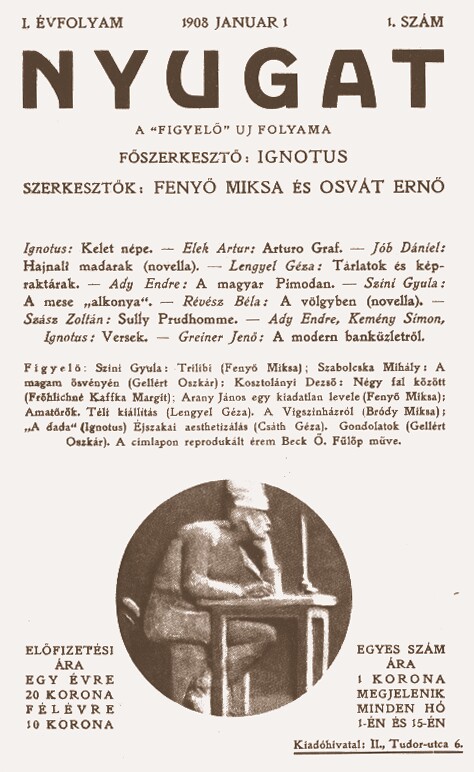
This summer saw the publication of our jointly authored chapter, “Looking for the World in Hungarian Literature: Foreign Authors in Early Twentieth-Century Periodicals”, written with Jessie Labov, Szilvia Maróthy, and Róbert Péter. The chapter is published in Hungarian Literature as World Literature, edited by Péter Hajdu and Zoltán Z. Varga and published by Bloomsbury Academic.
Growing out of our collaborative research at the Digital Humanities Laboratory of the University of Szeged, the chapter reflects the sustained hard work, expertise, and commitment of the entire team. An important part of the project was our use of the tool, AVOBMAT—Analysis and Visualisation of Bibliographic Metadata and Texts—which supported our analysis and visualisation of patterns among the foreign authors represented in A Hét and Nyugat. It was a genuine honour to work alongside such dedicated colleagues and contribute to this publication, and I am immensely proud of what we achieved together.
Hungarian Literature as World Literature reconsiders Hungarian literature not as an isolated national tradition, but as an open geo-poetic and geopolitical space shaped by translation, cultural circulation, appropriation, and transnational exchange. Instead of measuring Hungarian works against a fixed international canon, the project investigates how literary forms, genres, ideas, and identities move between languages and cultures. It consequently challenges the rigid opposition between national and world literature, demonstrating that Hungarian cultural identity has always developed through dialogue with European and, more recently, global traditions.
Edited by Péter Hajdu and Zoltán Z. Varga, the English-language volume comprises an introduction and twenty-one case studies covering Hungarian literary culture from the fifteenth century to the present. Its five thematic sections address early European intellectual networks, literary constructions of national identity, geo-poetical affiliations, the relationship between literature and political history, and the international circulation of Hungarian literature through translation, theatre, and film. As a collaborative and inter-institutional research project, the volume situates Hungarian literary history within broader comparative debates while making its distinctive Central European experiences accessible to an international readership. For further details visit the project and book overview.
Chicago author–date reference:
Labov, Jessie, Szilvia Maróthy, Róbert Péter, and Zoltán Kocsis. 2026. “Looking for the World in Hungarian Literature: Foreign Authors in Early Twentieth-Century Periodicals.” In Hungarian Literature as World Literature, edited by Péter Hajdu and Zoltán Z. Varga, 89–104. New York: Bloomsbury Academic.